


-
$289.00 – $1,199.00
-
$239.00
-
$2,199.00 – $2,399.00
-
$189.00
-
$319.00
-
$879.00
-
$2,399.00
-
$5,799.00
-
$299.00
-
$469.00
-
$399.00
-
$149.00


Develop valuable motor skills while rolling on ride-on toys from Play with a Purpose!
Ride-on toys give you an engaging way to help children move their whole bodies, make choices, and explore under their own power.
In your facility, ride-on play does a lot more than keep children moving. As they pedal, push, steer, and share the riding area, children build important skills like coordination, balance, hand strength, communication, and turn-taking, often without even realizing they're learning. Ride-ons also bring plenty of smiles, confidence, and opportunities for imaginative play.
Choosing the right ride-ons can make your play space safer, smoother to manage, and more enjoyable for everyone. By considering factors such as age recommendations, seat height, weight limits, surfaces, and intended use, you can help children ride comfortably while selecting equipment designed to stand up to everyday use.
Use this guide to explore different ride-on options and find the best fit for the children, space, developmental goals, supervision practices, and storage needs in your program.
6 ways ride-on toys support early childhood development
1. They trigger significant gross motor development
Pedaling and pushing engage the large muscle groups children rely on for running, climbing, jumping, and keeping up with everything else on a playground. Legs and core work together to create and sustain momentum, and steering develops coordination and grip strength. A child circling a path for ten minutes is doing sustained, whole-body work that's difficult to replicate with indoor equipment.
2. They strengthen fine motor skills
Gripping and steering handlebars strengthens small muscles in fingers, palms, and wrists; which are the same small muscles children rely on later for holding a pencil, using scissors, and fastening buttons.
3. They provide sensory regulation
Pedaling and propelling with the feet deliver the kind of deep, resistive input characterized as heavy work by early childhood professionals. This can have an organizing and calming effect for many children, helping them prepare for more structured classroom activities like circle time or table work.
4. They improve balance and coordination
Trikes and foot-to-floor ride-ons build reciprocal bilateral coordination, where the legs alternate in a steady rhythm. Scooters develop unilateral coordination instead, with one foot planted while the other pushes. Balance bikes refine balance further, letting children find their own center of gravity with both feet still able to reach the ground. Steering adds another layer, since children coordinate their movements with what they see ahead.
5. They instill confidence and independence
Choosing a direction and getting there without help is a formative experience for a two-year-old. Ride-on toys give children control over their own movement, and the confidence that follows tends drive a willingness to try other new things!
6. They spark imaginative and social play
A trike ride can be more than you'd expect! Imaginative kids transform a simple ride into a package delivery, a fire rescue, or a trip to the store. Two-seat models encourage turn-taking. Traffic signs and paths turn a playground into a shared space with rules everyone follows. Along the way children practice focus and attention, problem-solving, communication, and collaboration, which are the cognitive and social skills that set them up for success across the rest of the day.
5 core types of ride-on toys
You can build most early childhood riding areas around four core types of ride-ons. Specialty models can be added to the mix to give children new ways to move, cooperate, and imaginate!
|
Ride-On Type |
How Children Use It |
Skills It Builds |
Where It Works |
|
Foot-to-floor ride-ons |
Pushing along with both feet on the ground |
Reciprocal bilateral coordination, balance, early social play |
Indoor or outdoor, smaller footprints. Smooth surfaces |
|
Trikes |
Pedaling on and steering the front wheel. Three-wheeled design creates stability |
Intorduction to pedaling, leg and core strength, fine motor grip, early steering skills |
Indoor or outdoor, open path or playground. Smooth and rough surfaces depending on model. |
|
Balance bikes |
No pedals. Striding with two feed and gliding from a seated position |
Refined balance and weight shifting that builds bike-readiness |
Smooth surfaces, ideally with plenty of open space for children new to bike-riding and developing balance |
|
Scooters |
Standing and pushing with one foot, balancing on lead foot planted on scooter base |
Unilateral coordination, two-wheeled balance from a standing position. |
Smooth, hard surfaces outdoors accommodate scooter wheels best. |
|
Specialty ride-ons |
Varies by design |
Cooperative play, upper body work, dramatic play |
Varies |
Foot-to-floor ride-ons
Best for: Ages 1 to 3, and any child capably walking, but not yet pedaling.
Foot-to-floor models give you an approachable option for toddlers and children who are not yet ready to pedal. Children sit and push with their feet on the ground, allowing them to begin and stop using familiar movement skills. This can help children practice steering, coordination, and independent movement at their own pace.
A low seat and wide base can provide added stability, depending on the model. As children walk and steer, they develop leg strength, upper-body control, and coordination as they navigate around the obstacles in front of them.
Many foot-to-floor designs lean into dramatic play. Styled as cars, trucks, or animals, children's imaginations can run wild as they become police officers, firefighters, zookeepers and more! Browse the foot-to-floor ride-ons range to see the styles available.
Trikes
Best for: Ages 2 to 8, depending on the model, size. Children large enough to successfully reach and propel the pedals!
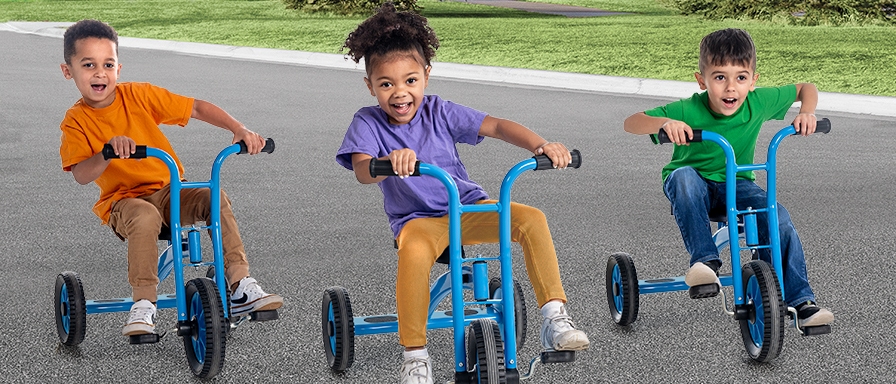
Trikes are the quintissential introduction to bike-riding! The simple design is inherently balance, helping kids get the hang of pedaling and steering without worrying about balance yet.
While trikes share the three-wheeled design, there's a lot of variety out there! Here's a few of the highly popular models we carry at Play with a Purpose to illustrate the range of designs.
Little Movers Trikes by Play with a Purpose are built to last! They pair a robust powder-coated steel frame with spoke-free wheels on ball bearings and heavy-duty tires that never need inflating. They're a dependable everyday choice for a busy program.
Winther Viking Premium Trikes are built for centers whose trikes are seeing consistent use. These trikes carry durability-forward features including pretreated powder-coated metal, and weather-resistant rubber seats and handlebars. They also have several features designed to improve the experience children have on the trike, including raised-back ergonomic seats for longer comfortable rides, and non-slip pedals on a solid one-piece steel crank. Multi-size sets cover a mixed room in a single purchase.
Winther Circleline Trikes help you support indoor or outdoor riding with age-specific sizes for children ages 2 to 8. Weather-resistant polyethylene seats and rubber-covered handles simplify care, while the no-sharp-edge design and built-in steering limiter add child-focused design features.
Angeles SilverRider Trikes bring a chrome-plated welded steel frame with solid, spokeless tires for a smooth ride and very little maintenance. Multi-size sets are available.
For smaller riders, Winther Duo Trikes start at a 10" seat height with spokeless wheels, rounded edges, and non-slip pedals. One model in the line adds a tray children love to load with treasures.
Two-seat models add an opportunity for social engagement and cooperative dramatic play. A Circleline Taxi lets children take turns as driver and passenger; the Winther Viking Twin Taxi seats a driver plus two passengers on a wide bench with a backrest and footrest, and Circleline Community Vehicles styled as police, fire, and school vehicles include a push-out stop sign and safety handrails.
Balance bikes
Best for: Ages 2 to 5, and children ready to progress past a trike.
Balance bikes look like a typical bicycle frame with no pedals. Children stride along from a seated position with both feet reaching the ground, propelling them forward. Eventually they gain enough speed and momentum to practice gradually lifting their feet and gliding - developing the balance necessary to progress to true bicycles!
Look for a seat height that lets the intended rider place their feet securely on the ground with their knees below their hips. Confirm the manufacturer's age and weight guidance before purchase.
The Little Movers Balance Bike uses a low crossbar and pedal-free design to help children ages 2 to 4 get on, get off, and practice balance and coordination.
Scooters
Best for: Ages 3 and up
Scooters offer a different experience to other ride-ons. Standing on one foot while pushing with the other develops unilateral coordination from a standing position, which complements the other physical skills children build on trikes, balance bikes, and foot-to-floor models.
Three-wheel designs give newer riders an approachably stable platform to learn on whereas two-wheel models require greater stability and coordination. Steering varies by design, with some scooters turning through weight shifts and others using handlebars that turn much like a traditional bike or trike. Scooters need a smooth, hard surface, so they're best suited to a paved play area or a gymnasium rather than grass. Browse these scooter options to compare designs.
Specialty ride-ons
Once the four core types are covered, specialty models add novelty and unique movement that can develop new physical, cognitive, and social skills.
Side-by-side riders seat multiple children at once and encourage cooperation as children scoot, pedal, and ride together in single direction.. The Winther Sofa Surfer Rider is a good example, suiting children who haven't yet mastered pedaling and pushing two riders to coordinate their movements. Ages 2 to 4.
Other options seat a driver and passengers, where one child pedals and the rest ride along, which creates a different kind of social play built around roles rather than shared effort. The Winther Circline Taxi is a good example. Models powered by arms rather than legs open ride-on play to children who find pedaling difficult and obviously develop upper body muscles. Larger-frame options like the Winther Chopper Trike suit older preschoolers ready for more speed, with a bigger front wheel and a 16"H seat.
Ride-on packs
If you're setting up a ride-on area from scratch, packs offer a convenient, all-in-one solution to get your space up and running.
Trikeopolis Packs are the most complete option, combining trikes, a pedal path, a playhouse, road signs, and helmets into a full dramatic play environment where children direct traffic, navigate intersections, and obey signs. Buying it as a pack saves you specifying each piece and confirming they work together. The full pack needs a use zone of roughly 40' x 38', and Mini Trikeopolis fits a tighter footprint at roughly 37' x 21'. Ages 2 to 10.
Winther Ready to Ride Trike Packs pair trikes with road signs and an interactive stop light with a hand crank that changes colors, which turns rules of the road into an activity children run themselves.
Smaller packs work well for a single classroom. Little Movers Trike Packs pair trikes with directional poly spots and traffic signs for building a course, and Deluxe Trike Packs combine several vehicles with cones and signs.
Find the right ride-on toys for your program
When you match ride-ons to the children, space, surface, and goals in your program, you give children opportunities to develop strength, coordination, movement, independence, and cooperation through play. When shopping ride-on toys, look no further than Play with a Purpose, where we've built equipment designed to withstand the punishment your kids will put to it for over 75 years. Every ride-on is of the highest-quality, and backed by our Unconditional 100% Satisfaction Guarantee.
Looking to learn more from an expert? Give us a call, email, or explore our full selection of ride-on toys, storage, and accessories!
Choosing the right ride-on toy: 6 key questions to ask
The best trike or ride-on toy for your program depends on more than age alone. The right choice should fit your children's developmental stage, support the skills you're working to build, match your available space, and stand up to the demands of everyday use.
As you compare options, think beyond the ride-on itself. Consider who will be riding it, where they'll use it, how often it will be shared, and what you want children to gain from the experience. Whether you're outfitting a toddler room, expanding your outdoor learning environment, or refreshing an established riding area, asking a few key questions can help you narrow the choices and invest in equipment that will serve your program for years to come.
Use the considerations below to determine which trikes, balance bikes, scooters, ride-on toys, and multi-rider vehicles best fit the needs of your children, staff, and learning goals.
1. What age of kids will use it?
One of the most common questions we get is "Which ride-on is best for my (fill-in-the-blank) year old?". Age does provide you with an adequate starting point when determining what ride-on options are worth evaluating. The chart below features a rough outline of the different "best-fits" for ride-ons by the age of kids you're supervising.
| Best Ride-On Toy Type by Age | ||
|
Age |
Recommended Ride-On |
Why It Fits |
|
Ages 1 to 2 |
Foot-to-floor ride-ons |
Feet remain near the ground, helping children start and stop while practicing steering and coordination |
|
Ages 2 to 3 |
Trikes with a low seat, foot-to-floor |
Low-seat models may support early pedaling when children fit the product and can operate it comfortably |
|
Ages 3 to 4 |
Standard trikes, balance bikes, 3-wheel scooters |
The sweet spot age range for trikes and balance bikes as kids have the physical skills and size necessary to use them successfully. |
|
Ages 4 to 5 |
Larger trikes, balance bikes, scooters |
Entering the ages where balance and control of the bike improves, they can better receive and implement instruction. |
|
Ages 5 and up |
Large-frame trikes, 2-wheel scooters, bicycles as skills progress |
Children are typically physically capable of learning to successfully ride a bike, but are likely still consistently using larger scooter and balance bike options as they transition to full bicycles. |
Although age works for general guidance, be certain to evaluate the following as well in determining what ride-on toy is right for your kids!
- Always be sure to check seat height and weight limit against the children you're supervising. Don't purchase a ride-on that falls short of the size requirements of your kids.
- A child should sit with hips above the pedals and reach them comfortably through the full pedal cycle.
- A child should be able to sit on the seat with both feet reaching the ground on a foot-to-floor ride-on, or the pedals at their furthest point on a trike.
- At the top of a cycle, the knee should never sit above the hips.
2. Which skills are you trying to develop?
Different ride-on toys encourage different types of movement, and the best choice depends on what you want children to practice. Beyond simply getting from one place to another, riding activities can help children develop gross motor skills, coordination, balance, spatial awareness, confidence, and social interaction. Many early childhood programs intentionally include a variety of ride-on options because no single vehicle supports every developmental goal.
For children building leg strength, endurance, and bilateral coordination, trikes provide the most sustained physical activity. Balance bikes help children learn weight shifting, steering control, and dynamic balance, making them a natural stepping stone toward riding a bicycle. Scooters place greater emphasis on unilateral coordination because children propel themselves with one leg while balancing on the other.
Social and cognitive skill development deserves consideration as well. Two-seat vehicles, cooperative riders, and dramatic play ride-ons encourage communication, turn-taking, problem-solving, and imaginative play. Children naturally negotiate roles, destinations, and shared goals while riding together, creating opportunities for language development alongside physical activity.
Setting age aside, you can generally follow these guidelines to choose a ride-on type based on the skills you're looking to cultivate in the kids you supervise:
- Choose trikes when your priority is: leg strength, stamina, pedaling skills, and bilateral coordination.
- Choose balance bikes when your priority is: balance, body control, and bicycle readiness.
- Choose scooters when your priority is: unilateral coordination and balance.
- Choose multi-rider and dramatic play vehicles when your priority is: social interaction, communication, cooperation, and imaginative play.
3. What are your safety considerations?
Of course it's always best practice to support safer ride-on play by matching equipment to each child, following manufacturer guidance, inspecting products regularly, defining the riding area, and providing active supervision. However, within each ride-on type, the following characteristics or benefits should be considered when evaluating what product is right for your kids!
- Stability comes from a wide wheel base and a low center of gravity, which matters most for the youngest riders. Three wheels give a stable platform while children learn to steer.
- For protected hands and feet, look for rounded edges, non-pinch hinges, non-slip pedals, and a steering limiter that stops the front wheel from turning far enough to catch small fingers.
- Secure grip is a must have, and is determined by the ride-on toy's handle material and texture. The right handles help children hold on confidently and avoid the small slips and accidents you'd otherwise be responding to.
Use your center's policies, applicable regulations, product instructions, and recognized safety guidance to establish helmet procedures. For wheeled riding toys such as trikes, balance bikes, and scooters, helmets can be incorporated into your program's safety routine. Store properly fitted helmets near the riding area so staff can apply the routine consistently.
A defined riding area is another major safety consideration. A pedal path or a marked course keeps riders away from foot traffic and gives you clear sightlines, so you can supervise the whole group from one position.
4. Where will children ride?
Your space and surface available can also be a key determining factor in purchasing the right ride-on toys for your facility.
Indoors favors foot-to-floor ride-ons and smaller trikes with non-marking wheels. Indoor ride-on toys need to turn in tight quarters, so a shorter wheelbase helps. Many ride-ons are rated for indoor and outdoor use, so one purchase often covers both.
If you have access to a large, smooth pavement area outdoors then virtually all options can work. Some ride-on types like scooters need a smooth hard surface to work properly. If your ride-ons will mainly be used and stored outdoors, consider weather-resistant materials and a durable finish like those on Play with a Purpose's own Little Movers Trikes and Balance Bikes.
On grass or rough ground, a pedal path changes what's possible. Grass stops trikes quickly and makes pedaling difficult for small children. A Pedal Path over the top of it turns unusable space into a riding area. Looking for a path and ride-on all-in-one package that fits in a small space? Mini Trikeopolis exists for exactly this reason, fitting a full dramatic play setup into roughly 37' x 21', so a smaller yard doesn't cost you the activity.
5. How durable does your ride-on toy need to be?
This is where commercial-grade equipment really sets itself apart from lower cost options sold for family-use.
In a childcare or preschool setting, the same ride-on will obviously be shared by many children and used frequently. Choosing products developed for preschools or centers, with durable frames, wheels, bearings, seats, and grips, can help you get the most life out of your ride-on. Store your trikes, bikes, and scooters according to manufacturer guidance rather than assuming they can remain outdoors.
What to look for in a durable ride-on:
- Frame material is the first indicator. Powder-coated or pretreated steel resists rust and holds up to constant use. Chrome-plating on hardware or frame parts and welded steel offer additional long-lasting performance. Molded polyethylene handles rather than weak rubber weather well and cleans easily, which matters in a shared setting.
- Then comes wheels and bearings. Solid, spoke-free tires never go flat and have nothing for fingers to catch. Industrial ball bearings keep wheels rolling smoothly after thousands of trips.
- Seats and grips can take more wear and tear than you might expect. Weather-resistant rubber and polyethylene are quality handle materials that survive rain and sun, and they wipe clean between users.
A note on weight limits. These vary significantly by manufacturer and may not compare apples to apples. Weight limit can be a good data point to gather and ensure that your children fall within the stated range, but don't rely on it as a proxy for durability. Instead, focus on the materials used in the ride-on's frame, hardware, handles, and wheels.
6. Does variety matter for your facility?
If your kids are bored with typical trikes, bikes, and scooters; adding novel and unique ride-on toys to your facility can reengage them!
You likely know well that children gravitate toward whatever's new! A vehicle with an unusual shape, a different way of moving, or room for a passenger gives them a fresh reason to ride. For you, that's the difference between self-sustaining play time and a chorus of "We're boooooored!"s! For added variety consider:
- Cooperative models that need several riders working together
- Themed models and accessories that bring an element of dramatic play into ride-on activities
- Obstacles that create added challenges for experienced riders!
Variety in ride-on play also broadens participation. A child who finds pedaling difficult may take happily to an arm-powered model, and a child who prefers company may join a two-seat vehicle with a friend.
Ride-on storage, paths, and accessories
Ride-on toys are the foundation of the play area. Storage protects that investment, and accessories turn open pavement into a place with destinations, rules, and stories.
| Guide to Common Ride-On Accessories | ||
|
Accessory |
What It Solves |
Best For |
|
Pedal path |
Grass and rough ground stopping trikes |
Programs riding outdoors without pavement |
|
Trike shed |
Weather exposure and scattered storage |
Outdoor play areas, while promoting dramatic play |
|
Trike rack |
Trikes tipping and taking up floor space |
Indoor storage and tight spaces |
|
Traffic signs |
Riders needing structure and turn-taking |
Programs teaching rules of the road |
|
Bridge |
Riding becoming repetitive |
Programs adding challenge and route variety |
|
Helmets |
Supports your established helmet procedure |
Programs following center policies, applicable regulations, product instructions, and recognized safety guidance |
Pedal paths
A pedal path is the single accessory that changes what a play area can do, because most childcare centers have grass where they'd like a riding surface.
Interlocking panels create a firm, level track over grass or uneven ground, so children can build real momentum instead of stalling every few feet. If your outdoor space is mostly lawn, a path is what makes the trikes you already own worth bringing out. That momentum is what makes pedaling worth doing, and it's where the sustained gross motor benefits come from.
The Pedal Path is built from recycled, impact-resistant thermoplastic olefin with stainless-steel tamper-resistant hardware, and drain holes around the edges keep water off the track after rain. Several set sizes are available, including a figure-8 layout with a 4-way intersection for programs teaching traffic rules. Ages 2 to 10.
Sheds and racks
Trikes left out in weather age quickly, and trikes piled in a corner get damaged by each other.
A trike shed solves both while doing something extra: Children treat it as a garage, which makes putting equipment away part of the play rather than a chore. A trike rack keeps trikes upright and organized in a smaller footprint, which suits indoor storage or a tight equipment area.
Either option means a child can select a trike and return it with less help. That supports their independence, and it gives you back the minutes that collecting scattered equipment usually costs.
Traffic signs and bridges
Accessories help turn riding in circles into a game with rules.
Traffic signs give children something to read and obey. Stopping at a sign requires attention, impulse control, and an understanding that rules apply to everyone, and children learn accountability as they start holding each other to them.
A trike bridge adds a physical challenge to the route. Approaching an incline, judging speed, and steering through a narrow section all ask more of a rider than flat ground does. It also gives confident riders somewhere to progress, and it's simply fun, which is reason enough.
Adding a destination along the route, like a playhouse, gives children somewhere to ride toward and turns a loop into a story.
Together these turn a plain surface into a small town, which is the setup the larger packs are built around.